Recycling and Sustainability for Commercial Waste Removal Crouch End
 Commercial Waste Removal Crouch End is committed to delivering an eco-friendly waste disposal area approach for local businesses. Our commercial recycling services in Crouch End focus on practical, measurable outcomes that reduce landfill and support a circular economy. We work alongside local commercial clients to create bespoke waste plans that prioritise reuse, responsible recycling and carbon reduction. This page outlines our sustainability targets, how we integrate with borough systems, and the partnerships that make our sustainable rubbish area strategy effective.
Our approach to commercial waste management in Crouch End is rooted in transparency and ambition. We set a clear recycling percentage target for commercial customers and monitor progress monthly, using route-level data to optimise collections. By combining segregation at source with smart on-site containers, we minimise contamination and boost recycling yields for materials like paper, cardboard, glass, mixed plastics and food waste.
 Local context matters: Crouch End sits within the London Borough of Haringey, and our services align with Haringey's borough approach to waste separation and less wasteful consumption. We support the borough's initiatives such as separate food waste streams and targeted dry recycling campaigns, helping businesses meet local regulations and waste separation standards while contributing to community targets.
Targets, Metrics and the Sustainable Rubbish Area
Setting robust targets is central to an effective sustainable rubbish area for commercial clients. Our standard goal for new contracts is a 70% recycling rate within the first 12 months, with an aspirational aim of reaching 80%+ through continuous improvement. These targets are not arbitrary — they are based on bin audits, material flow analysis and collaboration with clients to reduce unnecessary waste generation at source.To reach these numbers we implement practical measures: improved segregation, staff training, regular waste audits and visual signage. We encourage businesses to establish dedicated recycling zones and standardised labelling so that waste streams remain clean and economically recyclable. Our teams provide on-site support during roll-out and run follow-up audits to ensure targets are met.
In operation this means offering a mix of containers for paper and cardboard, glass, plastics and organics, combined with scheduled collections for dry mixed recycling and food waste. Commercial recycling in Crouch End is therefore both a logistical service and a behaviour-change programme that reduces disposal costs while improving diversion rates.
Low-Carbon Fleet and Transfer Stations
Our low-carbon vans form a core pillar of our eco-friendly waste disposal area. We operate a growing fleet of Euro 6 and electric-assisted low-emission vehicles, designed to cut CO2 and NOx emissions on dense urban routes. Reducing vehicle emissions is one of the most impactful steps toward greener commercial waste removal in Crouch End.We also make use of local transfer stations and consolidation hubs to reduce mileage. By combining loads and routing via nearby transfer facilities, fewer journeys are required and more material reaches recycling processors efficiently. Our routing partners include regional transfer stations commonly used across North London, chosen for their high diversion rates and robust material sorting capabilities.
These transfer stations enable economies of scale for sorting and onward recovery; they also allow us to provide clients with material-specific reporting, ensuring materials collected from a sustainable rubbish area are tracked to their next life — reprocessing, remanufacture or energy recovery when necessary.
Charitable Partnerships and Circular Economy Activities
We actively partner with local charities and social enterprises to maximise reuse. Donations of furniture, office kit and textiles are coordinated through vetted charity partners in Haringey and neighbouring boroughs, keeping usable goods out of the residual stream and supporting community benefit. These partnerships support our commercial recycling Crouch End promise to prioritise reuse before recycling. Examples of reuse pathways include:
- Office furniture and IT equipment refurbishment programmes run with charity partners
- Textile reuse and repair initiatives that reduce bulk textile disposal
- Food redistribution networks for surplus edible items from hospitality businesses
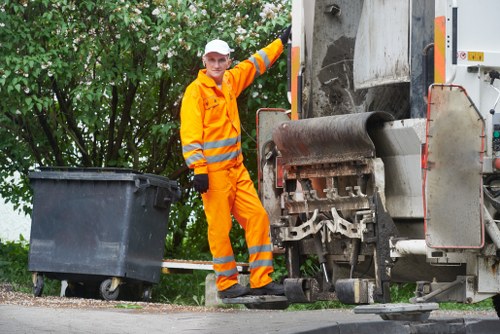 We maintain formal memorandums-of-understanding with local charities to ensure items are processed ethically and swiftly. This creates a reliable flow from a business's sustainable rubbish area to community benefit schemes, providing proof of diversion and social value alongside environmental impact.
Reporting and Continuous Improvement
All our commercial waste removal contracts in Crouch End include monthly performance reporting. Reports show recycling rates, contamination levels, vehicle emissions saved through route consolidation, and the tonnage diverted to reprocessors or charity partners. These metrics help businesses demonstrate corporate responsibility and comply with procurement or environmental management requirements.
We treat sustainability as an iterative process. Regular reviews, bin rebalancing and targeted engagement campaigns for staff and customers keep diversion rates climbing and costs down. By embedding a culture of recycling and resource efficiency in every commercial premises, we turn ordinary waste operations into an effective eco-friendly waste disposal area that benefits both business and borough.
What you can expect
When you choose our commercial waste removal service for Crouch End, you get:
- Clear recycling percentage targets (70% baseline, progressing toward 80%+)
- Use of local transfer stations to lower transport emissions
- Partnerships with charities to prioritise reuse
- Low-carbon vans and smart routing to minimise environmental impact
We are committed to building sustainable rubbish areas across Crouch End and neighbouring parts of North London, working in harmony with borough waste separation policies and the wider circular economy.
